.webp)
Clocking In on Palpagos: Palworld and the Strange Honesty of a Game About Work
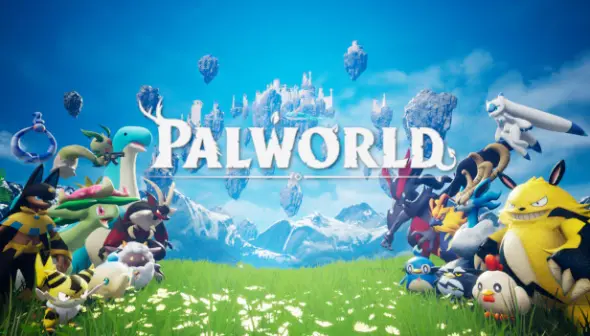
The key art for Palworld 1.0 contains a joke that the game has been telling, and refusing to stop telling, since the day it appeared. In the foreground sits a creature wearing a minigun. Behind it, a blue penguin-like Pal looks on with an expression of mild hope, a pink round creature peers out from the grass, a dolphin-shaped Pal glides alongside, a flowering plant-woman strikes a pose, and above them all a winged creature crosses the sky in front of a glowing tower. It looks like a party. It looks like a roster of mascots posing for a group photo. And yet the minigun is right there, bolted onto the animal, treated by the composition as just another costume accessory. That small, unembarrassed detail is the most honest summary of what Palworld is. It is a creature-collecting game that has decided not to pretend that collecting creatures is an innocent activity.
Palworld spent more than two years in Early Access, from January 2024 until Pocketpair declared version 1.0 on July 10, 2026, and in that time the world mostly discussed it through a single phrase: Pokémon with guns. It is a fun phrase and a useful one, because it explains the surface of the game in four words. But it is also a slightly misleading one, because it makes Palworld sound like a parody built around a single juxtaposition, and a parody built around a single juxtaposition does not usually survive for years. What has kept people playing is something less quotable and considerably stranger. Underneath the guns is a game about labor. Almost every system in Palworld, from catching to building to eating to fighting, is organized around one question that most creature games prefer to leave unasked: what exactly are these animals for?
This piece is an attempt to take that question seriously. It is not an argument that Palworld is a dark game, because it is mostly a cheerful, chaotic, surprisingly warm one. It is an argument that the cheerfulness is part of the point, that the game’s comedy and its discomfort are the same design decision viewed from two angles, and that the 1.0 release, with its new story, its new endgame, and its enormous wave of new Pals, is best understood as Pocketpair finally giving that decision a place to land.
The Genre Euphemism Palworld Refuses
Every creature-collection game contains a small, usually unexamined piece of ideology. You find wild animals, you capture them in a device, you carry them in your pockets, you send them to fight on your behalf, and you describe this arrangement with a word like partner, friend, or companion. The vocabulary is warm and the mechanics are not. The creature has no say in whether it joins you, no way to leave, and no life outside the use you make of it, and the genre has spent decades smoothing over that gap with charming animations and reassuring dialogue about the bond between trainer and creature.
Palworld’s contribution is to remove the smoothing. The creatures in this game are called Pals, a name that is deliberately as friendly as the genre’s usual vocabulary, but the game then proceeds to describe what Pals are actually used for with a bluntness that feels almost clinical. They gather. They haul. They mine, chop, farm, water, cook, generate power, and operate machinery. They fight, they carry you across the map, and in the grimmer corners of the game’s toolbox they can be turned into ingredients. Nothing in the design suggests that these roles are a betrayal of the player’s affection. They are simply what a Pal is for. The cute face and the job description sit side by side, and the game leaves it to the player to decide how comfortable that makes them.
What makes this interesting, rather than merely provocative, is how consistently the rest of the game supports it. A less committed design might have taken the premise as a gag and then retreated into the genre’s standard comforts, letting players ignore the labor and enjoy the fantasy. Palworld does the opposite. The labor is the fantasy. The central loop of the game asks you to build a base, populate it with captured Pals, assign them tasks, and watch an economy grow, and the pleasure it offers is the pleasure of administration: the satisfaction of a system running smoothly because you set it up well. The creature-collecting is in service of the management, not the other way around.
Work as the Central Verb
It helps to look at how the game actually asks you to spend your time. In most open-world creature games the dominant verb is encounter: you walk, something appears, you respond. In Palworld the dominant verb is assign. Each Pal has a set of work suitabilities, such as handiwork, transporting, farming, mining, lumbering, and kindling, and each suitability has a level, and your job as the owner of a base is to match creatures to tasks in a way that keeps everything moving. The game turns a roster into a workforce, and the roster screen starts to look less like a trophy case and more like a staffing sheet.
That shift changes the player’s relationship to individual creatures in a few specific ways:
- Value is measured by function. A Pal you would never bring into a fight might be indispensable at the base because of a high-level suitability that makes a whole production line run faster.
- Rarity and usefulness come apart. A common creature with the right skill set can matter more to your daily life than a rare one with spectacular combat stats, which breaks the genre’s usual equation of power with desirability.
- Capture becomes recruitment. Hunting for a particular Pal is often less about completing a collection and more about filling a gap in the base, the way a manager might scan for a missing specialist.
The result is a very different emotional texture from the trainer fantasy. You do not feel like a hero gathering allies. You feel like the founder of a small, growing enterprise, and the creatures are, quite literally, the staff. The game finds a surprising amount of humor and charm in that framing. A Pal hauling logs across a clearing, a Pal slumped over a workbench after a long shift, a Pal so devoted to its task that it keeps working in the rain: these are comic images, but they are comic because they are recognizably about work, and about the odd emotional intimacy of watching something labor on your behalf.
The Management Fantasy Underneath the Meme
Underneath the creature-collecting is a genre that Palworld borrows from more heavily than its marketing admits: the factory and logistics game. The best moments in the base-building loop have little to do with monsters and everything to do with flow. A resource is mined, carried, processed, stored, and consumed, and any weak link in the chain becomes a bottleneck that the player has to diagnose and solve. If the miners are fast but the carriers are slow, the storage fills up. If the farmers produce more than the cooks can handle, food spoils. Every base is a small puzzle of throughput.
This is where the game quietly earns its longevity. The pleasure of optimizing a production line is one of the most durable pleasures in game design, and Palworld attaches it to a fantasy that is easy to emotionally invest in. Instead of watching abstract conveyor belts, you watch creatures you recognize and have named, each with its own habits and quirks, moving through a space you built. The logistics become personal. When something goes wrong, it is not a number turning red but a particular Pal failing to reach its workstation, and the fix involves understanding that Pal’s role in the larger system.
The 1.0 release extends this side of the game rather than abandoning it. Pocketpair has described new base structures, furniture, building components, and even offshore building as part of the full launch, which suggests that the management fantasy is being treated as a first-class pillar of the experience rather than a side activity. Offshore construction in particular points to a game that expects players to think of their bases as sprawling, ambitious projects, the kind of thing you plan and expand over many sessions rather than throw up in an afternoon.
Needs, Breakdowns, and the Cost of Overwork
If the game stopped at efficiency, it would be a clever management sim with creature art. What gives it its edge is the way it makes the workforce vulnerable. Pals are not machines. They get hungry, they get tired, they get hurt, and their mental state deteriorates if they are pushed too hard. A base that is run purely for output will start to show the strain: creatures stop performing, moods sour, and in the worst cases a Pal can break down in ways that damage the very system you were trying to optimize.
This is the mechanical heart of the game’s discomfort, and it is handled with a light touch that makes it more effective rather than less. There is no lecture about exploitation. There is simply a feedback loop in which treating your creatures as pure inputs eventually costs you. Feed them well, give them places to rest, and they work happily. Ignore their needs, and the base begins to fray. The game never tells you that this is a moral lesson. It lets you discover that the efficient path and the decent path overlap more than a cynical player might expect, and that the exceptions to that overlap are where the real choices live.
What is most striking is how the game allows each player to decide where to stand. Some players build gentle, well-staffed bases with generous amenities and treat their Pals like valued employees. Others push the system as hard as it will go, extracting maximum output and managing the consequences with cold efficiency. Both approaches are supported, and neither is punished into irrelevance. That openness is a design achievement in itself, because it turns a mechanical system into a mirror. The way you run your base says something about how you play, and the game is curious enough to let you find out what.
There is also a darker option that the game does not hide: the creatures that can be turned into food. It is a detail that has generated its share of online argument, and it is easy to see why. But within the logic of the game it is entirely consistent. If Pals are workers, tools, and companions, it follows that they can also be resources, and the game’s willingness to complete that sentence is part of why it feels more honest than its peers. It does not need to dwell on the idea. It simply does not look away from it.
Guns, Rank, and the Same Logic Pointed Outward
Which brings us back to the minigun. The reason the key art works as a thesis statement is that the combat in Palworld follows exactly the same logic as the labor. You use firearms, you throw spheres, you send Pals into battle, and in 1.0 you can wield Pals more directly as weapons, a design direction Pocketpair has highlighted as part of the update. The shooting is not an incongruous genre mashup bolted onto a gentle creature game. It is the logical extension of a world in which every living thing is understood in terms of what it can do for you.
Seen from that angle, the guns stop being the joke and become the punchline to a longer setup. A game that treats creatures as workers will naturally treat them as soldiers as well, and a game that arms the player will naturally arm the creatures. The combat is the same economy, pointed at a different target. Where the base asks how much a Pal can produce, the battlefield asks how much a Pal can destroy, and in both cases the creature is a capability attached to a cute face.
The game reinforces this by pointing the logic back at the player. Bases are not safe by default. They can be raided, and the factions that populate the world have their own relationships to Pals and to power, some of them explicitly organized around exploiting creatures and others around liberating them. The result is a setting in which the central question of the game, what are Pals for, is also a political question, and the player is invited to decide which side of that question they want to live on. The tone stays light, the art stays colorful, and the argument continues underneath.
This is also why the combat holds up better than its premise might suggest. A shooter attached to a creature collector could easily have felt like two unrelated games sharing a menu. Instead, each mode feeds the other. Resources from the base improve your weapons. Pals trained for work or fight shape your options in the field. Raids test whether the base you built can protect itself. The loop connects, and the connection is the labor system.
What 1.0 Adds: A Thesis Needs an Ending
For years, the most common criticism of Palworld was not that its ideas were weak but that they lacked a destination. The base-building loop was compelling, the creature roster was huge, and the exploration was fun, but the game was in Early Access, and the long-term direction was uncertain. A design about labor needs a sense of what the labor is building toward, and for much of its Early Access life Palworld could only gesture at an answer.
The 1.0 release is Pocketpair’s attempt to supply one. According to reporting around the launch, the update centers the endgame on the World Tree, a massive structure that the studio has described as playing a central role in the expanded story, and adds Sky Islands as a new vertical biome, a new main storyline, refreshed quests, a large new land area, and more new Pals than any previous update, with more than twenty teased ahead of launch. PvP is positioned as a core part of the full release rather than an experimental mode, and new dedicated-server features, including server clustering, have been widely discussed among players who run their own worlds. A few of the changes are worth singling out for what they imply about the game’s direction:
- The World Tree as destination. An endgame built around a single enormous landmark gives the long grind a visible target, which is exactly what a management game needs to feel like it is building toward something.
- Sky Islands as vertical expansion. Adding height to a world that was mostly horizontal changes how bases, travel, and Pal roles can be imagined, and fits a game that has always cared about flight and mobility.
- A proper main story. A narrative spine gives the game’s factions, ethics, and world a chance to say something coherent rather than merely implying it through systems.
- Pals as weapons. Treating creatures as direct combat tools makes the game’s thesis about utility even more explicit.
Whether the new story actually engages with the labor question is something each player will have to judge for themselves. A game that has spent two years letting its mechanics speak for it now has to decide how much of that voice to hand to dialogue and cutscenes. The risk is that a story can flatten what a system left ambiguous. The opportunity is that a story can finally put words to the uneasiness the game has been cultivating, and give the player a way to act on it rather than simply feel it.
Pocketpair has also confirmed that Pal evolutions are not planned for 1.0, a notable decision in a genre where evolution is usually the main long-term payoff for attachment. In the logic of this piece, it makes a certain sense. A game in which creatures are defined by what they do rather than what they become has less need for the transformation fantasy, and more reason to invest in the breadth of the roster and the depth of the work systems instead.
Where the Joke Strains
It would be dishonest to present Palworld as a perfectly coherent argument. The game has real tensions, and a fair reading has to name them. The first is the gap between its tone and its themes. A game that is, on the surface, a cheerful romp through colorful islands is also making implicit claims about exploitation, and those two registers do not always sit comfortably together. Players who enjoy the comedy may find the darker implications intrusive, and players who find the implications interesting may find the comedy undercuts them. The game manages the tension better than most, but it does not resolve it, and the 1.0 story will be tested on whether it can hold both registers at once.

The second is repetition. Management games reward patience and punish monotony, and a loop built on assigning, hauling, and building can feel like a chore once the initial novelty fades. The best defense against that is variety, and the addition of new regions, new Pals, and a new endgame is clearly aimed at supplying it. But the long-term health of the game depends on whether those additions keep changing how the base feels to run, rather than simply raising the numbers.
The third is the pull of optimization. A game that lets players choose how to treat their Pals also lets players discover that the most efficient approach is not always the most humane, and a community that shares guides and spreadsheets will naturally converge on whatever yields the most output. The moral texture of the game can easily be flattened by a meta that treats every Pal as a number. Pocketpair’s best hope here is that the game’s charm and its emotional hooks are strong enough that players want to play differently than the spreadsheets suggest.
The fourth is practical rather than philosophical. Palworld 1.0 is not on Nintendo Switch or Switch 2, a fact tied to the ongoing legal dispute between Pocketpair and Nintendo, and the game’s availability across platforms is limited to PC and Xbox and PlayStation consoles. The legal cloud is also a reminder that the game’s most famous comparison has real-world consequences. The phrase that made Palworld famous is also the one that follows it into court, and whatever the outcome, it has shaped the conversation around the game in ways that have little to do with what it is actually like to play.
What a Game About Work Can Say
The most interesting thing about Palworld is that it is never quite sure whether it wants to be a joke or an argument, and it is better for it. A pure joke would have worn out within a few hours. A pure argument would have been insufferable. By committing to both at once, the game created something that is funny enough to keep you playing and uncomfortable enough to keep you thinking, and that combination is rare.
The 1.0 release is a bet that the combination can sustain a full game. It adds the structure that Early Access lacked, a story to hold the factions, an endgame to hold the grind, and a larger world to hold the sprawl, and it does so without abandoning the odd, specific energy that made the game famous in the first place. The creature on the key art still wears its minigun. The creatures behind it still look happy. The question the game asks, quietly and without ever raising its voice, is whether the player is comfortable with both facts at once.
For a genre built on the comforting fiction that the creatures want to be there, that is a genuinely different offer. Palworld does not tell you what to feel about it. It hands you a pickaxe, a workforce, and a world full of things that can be put to use, and it waits to see what kind of employer you turn out to be. That is a stranger and more memorable proposition than a punchline about guns, and it is the reason a game that began as an internet joke has become something worth taking seriously.